Your notes, in your voice.
NoteWright sits downstream of your AI scribe and rewrites its output to match how you actually document — your structure, your phrasing, your clinical reasoning density. Not a template. A learned representation of your style.
Built by a practicing family physician for his own charts. Opening to early users in 2027 — join the list to be first in.
The problem
AI scribes transcribe the encounter well enough. Then they hand you a note that reads like it was written by someone else — because it was. Generic structure, foreign phrasing, reasoning that's either padded or missing. The editing tax eats the time the scribe saved.
From scribe output to your note
Paste. Take your scribe's draft — any scribe, any format. If it produces text, NoteWright can work with it.
Restyle. Pick the note type. NoteWright rewrites the draft to match how you actually document — learned from your own examples and feedback, not a house template.
Scribe draft
54yo here for HTN f/u. Also has knee OA, stable.

Home BPs running 130s/80s on lisinopril 20 daily, tolerating fine, no side effects. Knee pain ~3/10 after standing a while — using diclofenac gel and doing the quad exercises. No rest pain, no locking or giving way, no swelling.

Exam: BP 132/84. Knee mild crepitus, no effusion, full ROM.

Plan: BP at goal — keep lisinopril 20, recheck 3 mo with BMP. Knee — continue conservative, talked about weight bearing exercise vs keeping up the quad strengthening program. Also touched on health maintenance.
Your note
History of Present Illness
54-year-old presenting for hypertension follow-up with stable knee osteoarthritis. Reports home BPs 130s/80s on lisinopril 20 mg daily, no side effects. Knee pain 3/10 with prolonged standing, managed with topical diclofenac and quadriceps exercises. No red-flag symptoms.
Physical Exam
BP 132/84. Knee with mild crepitus, no effusion, full range of motion.
Assessment & Plan
Hypertension Essential (primary) hypertension
Controlled.
Continue lisinopril 20 mg daily. Recheck in 3 months with BMP.
BP today 132/84; home readings 130s/80s.
Knee osteoarthritis
Stable.
Continue conservative management. Discussed weight-bearing exercise quadriceps strengthening program.
Health maintenance
***
Same encounter. Your structure, your phrasing. Finish. Resolve placeholders, accept or reject suggestions, and copy a clean note into your EHR. What you didn't decide stays visibly undecided.
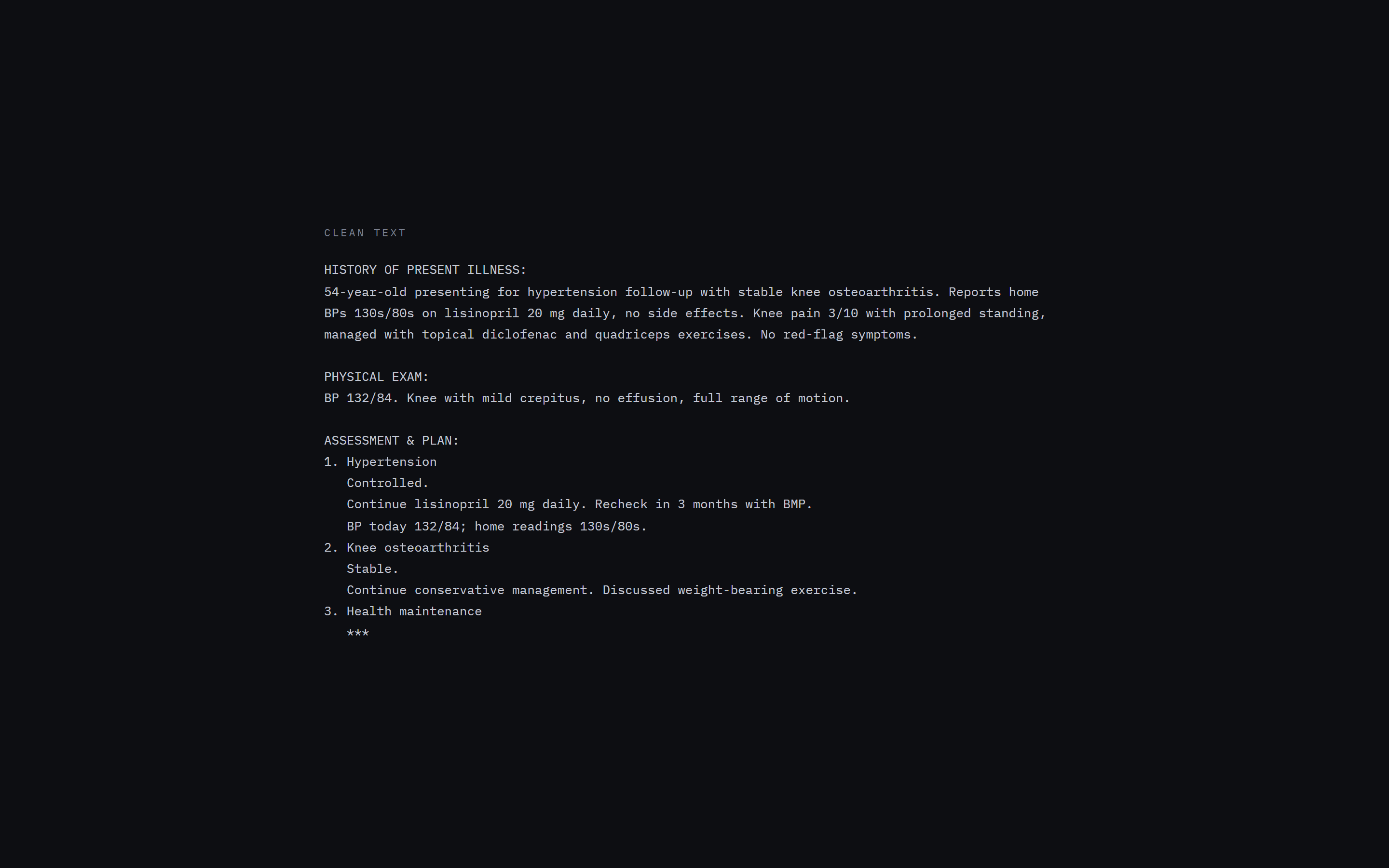
Unresolved means visibly unresolved — all the way to the EHR.
Principles
- Nothing is ever invented. If a value isn't in your input, it isn't in your note. Anything unresolved stays a
***— exactly where your eye, and your EHR, expect it. - You compose; it assists. Suggestions are transparent and yours to reject. No silent inference, ever.
- Your style belongs to you. NoteWright learns your documentation voice from your own notes and feedback — it doesn't impose a house style.
Built to grow with you
Get early access.
Join the list for early access and the occasional build log from the exam room.